Give every layer of packaging a job.
Custom packaging creates value when it protects the products, organizes the reveal, carries useful information or makes assembly and delivery more reliable. If a layer does none of those things, it may only add cost, weight and disposal.
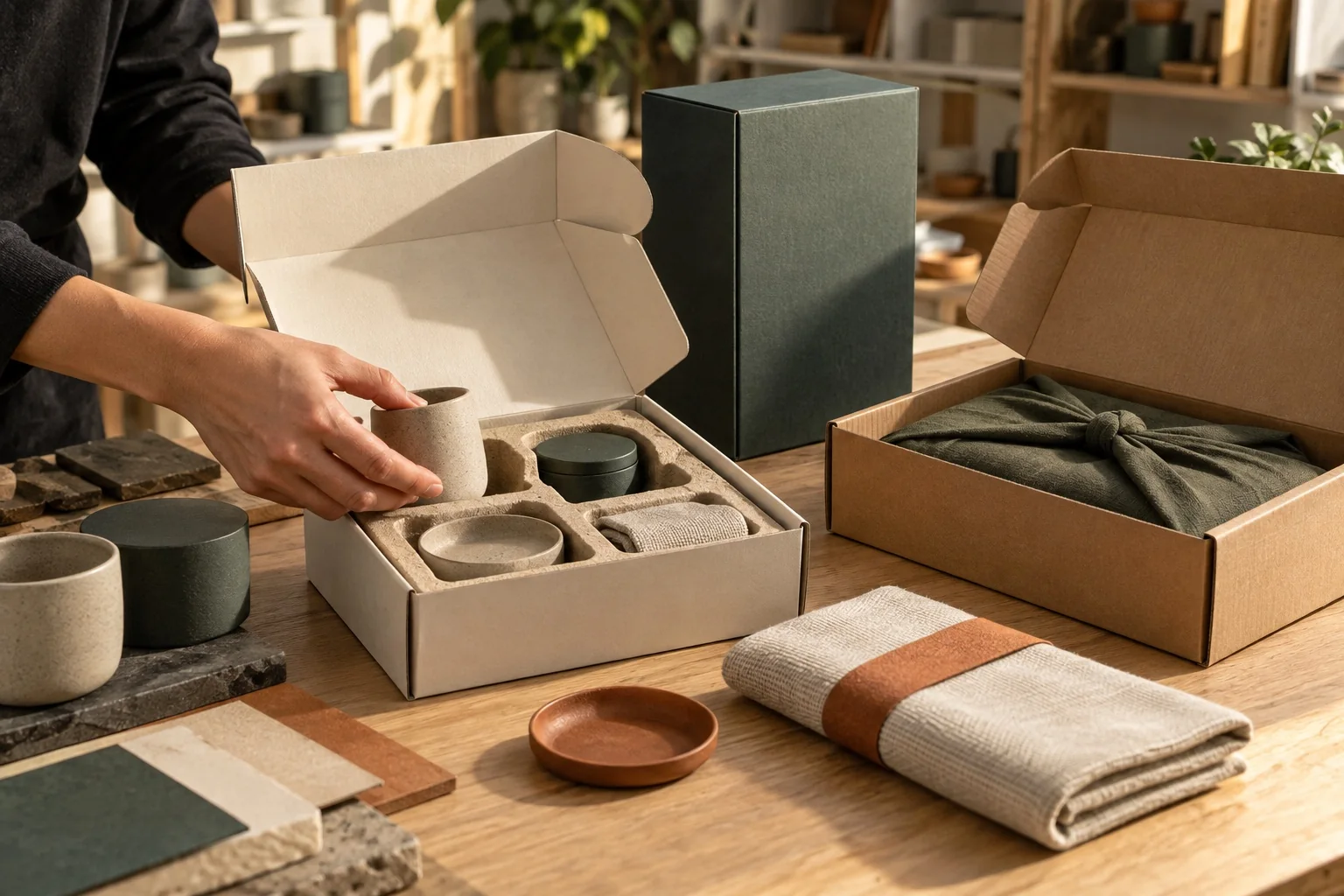
Choose the lightest structure that completes the experience.
Judge the package by what it accomplishes.
A beautiful box is not automatically a better system. These criteria keep the design connected to the product and the practical handoff.
Protect
Hold weight, edges, finishes and fragile areas securely through the expected handling route.
Organize
Control placement and sequence so the recipient understands the set without searching through filler.
Explain
Use the insert, label or inside panel to clarify the purpose of the gift and any next action.
Represent
Translate brand color, material character and tone without covering every surface in identity.
Assemble
Choose a structure the packing team can build consistently without hidden steps or weak closures.
Travel
Account for outer dimensions, void space, protection and the carrier rules that apply to the finished parcel.
Custom packaging is most useful when it solves more than appearance.
A fitted insert may protect mixed materials and control presentation. A textile wrap can become part of the keepsake. A compact printed sleeve may connect otherwise simple components. Each approach should justify its footprint.
- The structure matches the weight and fragility of the actual items.
- Void space is controlled so products do not collide or shift.
- The packer can repeat the intended presentation at project quantity.
- Brand elements remain legible after folds, closures and shipping labels.
- The finished outer size is reviewed before the design is approved.
Cost lives in more than the printed box.
Packaging can affect tooling, setup, assembly, storage, master-carton count and transport. UPS notes that shipping charges may use dimensional weight when a parcel occupies more space than its actual weight suggests. Compactness is therefore a design decision, not a last-minute shipping adjustment.
Four routes cover most early packaging decisions.
The final material and construction still require supplier and sample confirmation, but the route can be selected from the job the package needs to do.
| Standard protection | Mailer or stock carton | Best when products already present well and the main need is secure, efficient transport. |
|---|---|---|
| Organized presentation | Insert or divider | Useful when mixed components need a clear order, stable position or separation. |
| Brand narrative | Sleeve, card or inside print | Adds context and identity without rebuilding the complete outer structure. |
| Keepsake structure | Rigid or reusable format | Reserve for moments where continued storage, display or reuse justifies the added volume and cost. |
Comparing packaging routes for a real kit?
Share the product mix, quantity, destinations and desired handoff. We can review structure, branding, pack-out and transport implications before the packaging direction hardens.
Evidence behind this guide.
MerchWorthy uses this framework to give each packaging layer a defined job. The linked standards support transport facts; structure, materials and presentation still require project-level proof.
Custom Packaging for Corporate Gifts FAQ.
These packaging answers help separate functional structure from decoration that adds volume without solving a project need.
When is fully custom packaging worth considering?
Can a standard box still feel considered?
What information is needed before packaging design starts?
Why does dimensional weight matter?
Are sustainable packaging claims included automatically?
Comparing packaging routes for a real kit?
Share the product mix, quantity, destinations and desired handoff. We can review structure, branding, pack-out and transport implications before the packaging direction hardens.