Inputs already confirmed by the client or carried forward from an approved project.
Home / Our Process
Our process
One connected process from direction to delivery.
A custom merchandise program advances through clear decisions: what it must accomplish, which direction is feasible, what has been approved and what is ready to make, pack and ship.
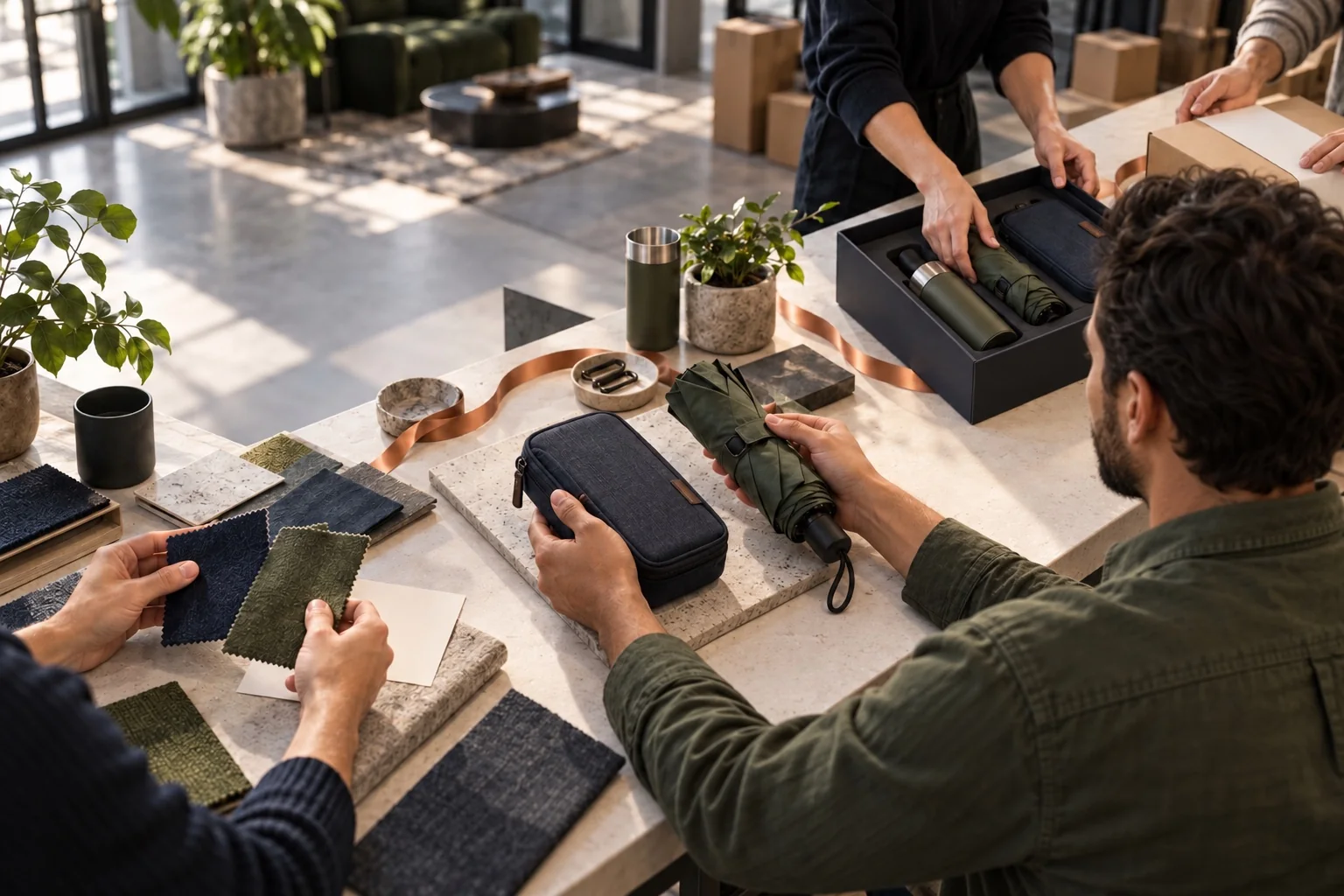
A route built around decisions
The next step begins when the right question is settled.
Some projects move directly from a shortlist to production. Others need samples, multiple versions, custom packaging or detailed destination data. We separate what is known from what still needs verification, so progress never depends on guesswork.
Product, supplier, decoration, packaging or route details that need evidence before commitment.
A recorded decision that releases the project into its next stage.
Eight decision gates
From brief to repeatable program.
Each stage identifies what you provide, what MerchWorthy coordinates and which confirmation moves the work forward.
Your input · business facts, preferences and approvalsOur work · curation, coordination and verificationAdvance when · the release condition for the next stage
01
Project brief
Turn an initial request into a working definition of the audience, moment, constraints and intended result.
Your input
Audience, purpose, quantity, budget range, required date and delivery model.
Our work
Organize priorities, identify missing information and flag conflicts that affect the route.
Advance when
The working brief and unresolved questions are understood.
02
Curated direction
Narrow the possibilities to a focused set of product and presentation directions with a reason behind each one.
Your input
Preferences, exclusions, brand context and reactions to the proposed directions.
Our work
Connect products, packaging and message to the business moment and recipient routine.
Advance when
One direction is selected for feasibility review.
03
Feasibility and sample path
Test whether the chosen idea can become a workable project under the actual specification and supply conditions.
Your input
Must-have functions, acceptable substitutions and any required evidence or sample expectations.
Our work
Review supplier options, decoration, preliminary specifications and the appropriate proof or sample route.
Advance when
The validation method and commercially viable direction are accepted.
04
Commercial and design approval
Bring product, artwork, quantities, versions, packaging and the quoted scope into one recorded decision.
Your input
Final artwork, quantities, version counts, destination details and decision-maker approval.
Our work
Consolidate confirmed specifications, proofs, sample findings and formal commercial terms.
Advance when
The complete production scope is approved without open contradictions.
05
Production release
Translate the approved scope into controlled production instructions rather than relying on visual references alone.
Your input
Any final authorization required under the agreed commercial arrangement.
Our work
Release confirmed specifications and monitor the checkpoints defined for the project.
Advance when
Pre-production details are locked and production can proceed.
06
Packaging and pack-out
Convert separate components into the correct finished version for each recipient group or destination.
Your input
Message copy, inserts, recipient versions, identifiers and distribution rules.
Our work
Define component maps, arrangement, assembly order, outer protection and version controls.
Advance when
The packing method and required variants are confirmed.
07
Quality and shipping readiness
Coordinate the checks agreed for the exact products and confirm that the shipment data matches the finished pack-out.
Your input
Timely decisions on any documented exception that changes the approved result.
Our work
Coordinate appearance, count, function or fit checks and reconcile packing with route data.
Advance when
The agreed release conditions have been met for shipment.
08
Delivery and continuation
Complete the confirmed handoff and preserve useful project knowledge for a reorder or adapted future program.
Your input
Receiving feedback, address changes and any new audience or program requirements.
Our work
Coordinate the agreed delivery path and retain the approved specification record.
Advance when
The project closes or a new brief is opened for the next run.
Three commitment points
Approval becomes more specific as the project advances.
A positive reaction to an idea is not the same as production approval. These three decisions prevent assumptions from carrying into the finished order.
Direction approved
The audience, intended response and overall product or packaging route are strong enough to verify.
Specification approved
The selected products, artwork, versions, quantities, commercial terms and required checks form one confirmed scope.
Shipment released
The agreed production and pack-out checks are complete, and the delivery data reflects what is actually shipping.
When conditions change
A responsible process can move backward.
Progress does not mean forcing a project through the next stage. If a new fact changes an approved assumption, the work returns to the last affected decision.
Change-control rule: product, finish, price, timing, packaging or recipient-impact changes are reviewed before a new commitment is made.
A sample exposes a problem
Revisit the specification, decoration or supplier direction before production approval.
Availability shifts
Evaluate substitutes against the same audience, function, appearance and project constraints.
Artwork or versions expand
Recheck proofs, counts, pack-out control and commercial impact before release.
Destination data changes
Reconcile addresses, routing, protection and timing with the confirmed packing plan.
What shapes the schedule
The calendar follows the confirmed route.
MerchWorthy does not publish a generic number of days for every order. Timing is built from the steps the project actually requires.
Existing samples, custom samples and artwork proofs create different review paths.
Artwork preparation, color matching and production setup vary by technique and surface.
Custom inserts, multiple components and specialized materials add dependencies.
Teams, locations, languages and recipient groups increase approval and pack-out control.
One receiving point and pre-arranged multi-address distribution require different data and handling.
Events, launches and handovers must be evaluated against production and transport feasibility before commitment.
After the first delivery
A reorder starts with context, not a blind repeat.
Past approvals create a useful baseline, but availability, material, price, quantity, artwork and destination requirements can change. We preserve what was approved and revalidate what may have moved.
Keep the approved specificationProduct, decoration, packaging, versions and final artwork form the reference record.
Record what changedRecipient feedback and operational notes can improve the next brief.
Reconfirm current conditionsA repeat order becomes binding only after its present supply and delivery facts are checked.
Before the project begins
Process questions.
These answers explain how decisions are sequenced. Exact specifications, commercial terms and delivery commitments remain project-specific.
How long does a custom merchandise project take?
A reliable schedule can be set only after the product, decoration, packaging, sample path, quantity and delivery route are understood. A fixed timeline is not published because those variables differ by project.
Does every project require a physical sample?
No. The appropriate approval path may use an existing sample, a custom sample, an artwork proof, a material reference or another project-specific review. The final route depends on risk, customization and what must be verified.
When are formal price and production terms confirmed?
They are confirmed after the selected direction and required specifications have been validated. Cathy approves binding prices, supplier selection, production commitments and delivery promises.
Can we begin with a product we already selected?
Yes. The process can begin at feasibility and specification review, while still checking decoration, packaging, quantity, timing and delivery requirements before production.
What happens if availability or a sample changes the plan?
The project returns to the last affected decision. Any change that alters product, finish, price, timing, packaging or recipient experience is reviewed before the next commitment is made.
Can a past project be reordered exactly as before?
Approved specifications can support a faster starting point, but current availability, pricing, materials, artwork, quantities and delivery requirements still need to be reconfirmed for the new order.
Begin at the stage you are actually in
Tell us what is decided—and what is still open.
You can arrive with a broad objective, a product reference or an existing specification. We will identify the next decision required to move the project responsibly toward production and delivery.